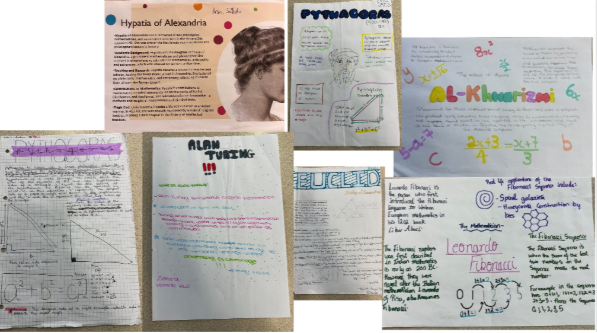
Mathematics
Overview
Mathematics is a core subject that develops logical reasoning, problem-solving, and analytical thinking. At Key Stage 3, students build on prior knowledge from primary school and begin to explore more advanced topics such as algebra, geometry, statistics, and ratio. The curriculum prepares students for GCSE study by developing fluency, confidence, and resilience in tackling mathematical challenges.
Curriculum Intent
The Mathematics department aims to:
-
Develop fluency in fundamental mathematical skills.
-
Build problem-solving and reasoning abilities.
-
Encourage students to think logically and critically.
-
Promote mathematical confidence and independence.
-
Prepare all learners for success at KS4 (Edexcel GCSE Maths).
-
Embed key values such as perseverance, accuracy, and curiosity.
Curriculum Implementation
Teaching Approach
-
Use of the Mastery approach: small steps, deep understanding, and variation.
-
Combination of teacher modelling, guided practice, and independent work.
-
Emphasis on mathematical vocabulary and reasoning.
-
Use of retrieval practice, questioning, and worked examples.
-
Differentiation through scaffolding, challenge tasks, and support materials.
Sequencing of Learning
-
Topics are structured to move from concrete → pictorial → abstract.
-
Core strands revisited regularly: Number, Algebra, Geometry, Statistics.
-
Skills are sequenced progressively across Years 7–9 to build depth.
Assessment
-
Regular formative assessment (quizzes, classwork, questioning).
-
End-of-unit assessments aligned to Edexcel style.
-
Termly summative assessments tracking progress.
-
Use of feedback and DIRT (Dedicated Improvement and Reflection Time).
Curriculum Impact
Success is measured through:
-
Student progress data and attainment in assessments.
-
Improved problem-solving and reasoning skills.
-
Student confidence and engagement (student voice).
-
Quality of classwork and homework.
-
Readiness for GCSE Mathematics.
Evidence includes:
-
Assessment results
-
Exercise books showing progression
-
Participation in discussions and independent work
Curriculum Structure
Key Stage 3
| Year | Topics / Units | Key Knowledge & Skills |
| 7 | Place Value, Four Operations, Fractions, Decimals & Percentages, Ratio & Proportion, Algebra Basics, Angles & Shapes, Perimeter & Area | Secure arithmetic skills, introduction to algebraic thinking, understanding of basic geometry and developing problem-solving strategies |
| 8 | Advanced Fractions & Percentages, Ratio, Algebra (Expressions & Equations), Angles, Polygons, Sequences, Graphs, Probability, Geometry (Area, Volume) Pythagoras theorem | Solving equations, manipulating expressions, analysing graphs, understanding probability, applying geometry formulas, reasoning mathematically |
| 9 | Calculations – calculator and non-calculator, Handling data, Higher Algebra, Angles, parallel lines, Statistics, Frequency graphs, Compound Measures, Fractions, decimals and percentages, Congruency, bearings | Multi-step problem solving, interpreting and drawing graphs, statistical analysis, preparation for GCSE-style questions |
Enrichment
-
Maths clubs and problem-solving sessions
-
Participation in UK Maths Challenge competitions
-
STEM projects and cross-curricular activities
-
Intervention and booster sessions
-
Educational trips (e.g. STEM events, university visits)
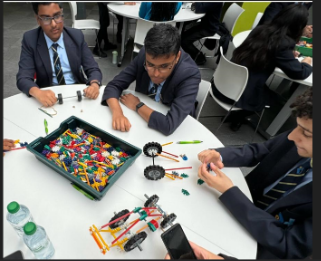
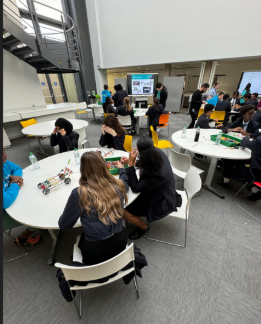
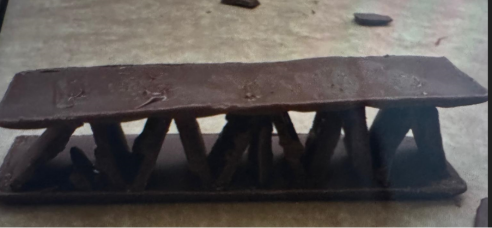
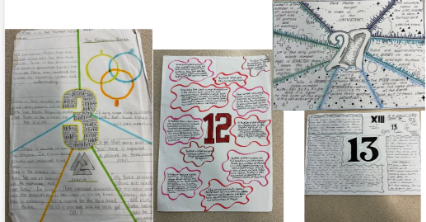
Graphs and geometry learning